
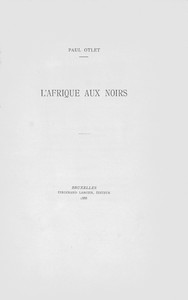
L'Afrique aux Noirs by Paul Otlet
Let's be clear from the start: this isn't a novel. It's a proposal. Published in 1928, L'Afrique aux Noirs is Paul Otlet's blueprint for what he saw as Africa's path forward. Otlet was famous for dreaming up the Mundaneum—a pre-internet vision of a global network of libraries and information. Here, he applies that same organizing zeal to an entire continent.
The Story
There's no plot with characters. Instead, Otlet lays out an argument. He critiques the brute-force colonialism of his era as wasteful and short-sighted. His alternative? A 'peaceful penetration' led by knowledge. He imagines a network of 'documentation centers' across Africa, spreading Western science, technology, and organizational methods. The goal, in his mind, was to modernize and uplift, preparing African nations for eventual self-governance... under a European-guided framework. The central tension is in his own contradiction: a desire to help, filtered through a paternalistic worldview that couldn't imagine Africa defining its own future.
Why You Should Read It
This book is a head-spinner. It's not 'good' in the sense of being right or morally sound by today's standards. It's important. You get inside the head of a progressive European thinker of the time and see the limits of that progressivism. Otlet genuinely believed he had a better, more ethical solution than the colonial掠夺 (plunder) happening around him. Yet, his solution still centers Europe as the teacher and Africa as the student. It's a stark lesson in how good intentions aren't enough. Reading it makes you question the hidden assumptions in any grand plan to 'fix' someone else's world.
Final Verdict
This is a niche but powerful read for anyone interested in the history of ideas, colonial mentality, or the roots of modern international development. It's not a beach read. It's for history buffs, students of post-colonial theory, or readers who like to engage with difficult, primary-source texts that reveal how people thought in the past. Pair it with works by African authors from the same period for the full, jarring picture.
No rights are reserved for this publication. Feel free to use it for personal or commercial purposes.
Daniel Torres
5 months agoVery interesting perspective.
Mary Lee
8 months agoI was skeptical at first, but the clarity of the writing makes this accessible. Exceeded all my expectations.
Steven Ramirez
1 year agoEssential reading for students of this field.
Lisa Lopez
4 months agoA bit long but worth it.

Donna White
1 year agoFinally a version with clear text and no errors.