
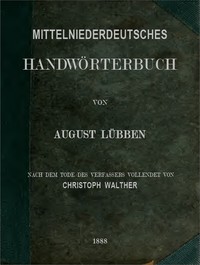
Mittelniederdeutsches Handwörterbuch by August Lübben
Let's be clear from the start: this isn't a novel. There's no protagonist or plot twist in the traditional sense. August Lübben's "Mittelniederdeutsches Handwörterbuch" is a dictionary. But its story is one of preservation. For over 500 years, Middle Low German was the powerhouse language of the Baltic and North Sea regions—the tongue of merchants, sailors, and city councils from London to Novgorod. Then, it began to disappear, replaced by other languages. Lübben, a 19th-century linguist, saw this history vanishing and spent his life chasing down its remnants. He scoured old legal documents, trade ledgers, and letters, compiling their words into this massive, authoritative guide. The 'story' here is the recovery of a lost world, one carefully defined entry at a time.
Why You Should Read It
You should peek into this book because it connects you to the gritty reality of the past in a way grand historical narratives often don't. Looking up a word like "Kogge" (a type of ship) or "Hanse" (the merchant league itself) isn't just about translation. It's about touching the daily life of a medieval trader. You get a sense of the humor, the disputes, and the sheer practicality of the people who built networks across Europe. It turns abstract history into something tangible. For me, the magic is in realizing how much vibrant human experience is locked in languages we no longer speak.
Final Verdict
This book is a specialized tool, but its appeal is broader than you might think. It's perfect for dedicated historians, linguists, or genealogists with North European roots who need a primary source. But it's also a fascinating artifact for the casually curious—the kind of person who loves museum archives or wonders about the origins of place names. If you're looking for a light weekend read, this isn't it. But if you've ever been captivated by the idea of hearing the past speak in its own voice, Lübben's dictionary is an essential key to unlocking it.
Legal analysis indicates this work is in the public domain. Access is open to everyone around the world.
Mary Lopez
8 months agoHaving read this twice, the storytelling feels authentic and emotionally grounded. I learned so much from this.
James Scott
1 year agoSurprisingly enough, the atmosphere created is totally immersive. Exactly what I needed.
Amanda Wright
1 year agoEssential reading for students of this field.
Mark Harris
1 month agoFive stars!
Elizabeth Torres
10 months agoI had low expectations initially, however the author's voice is distinct and makes complex topics easy to digest. I will read more from this author.