1

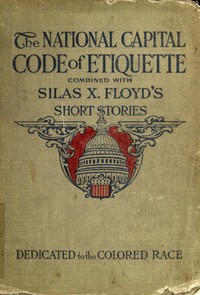
Silas X. Floyd's Short Stories for Colored People Both Old and Young Entertaining, Uplifting, Interesting — Key Ideas to Explore
10
3
Project Gutenberg
2019
Didactic fiction; Short stories, American; African Americans -- Fiction; African Americans -- Juvenile fiction
Readers of public-domain and historical texts
Project Gutenberg digital edition
en
Edition facts
Words: 56,635
Reading time: 247 min
Text sections: 8
Source:
Project Gutenberg record #60780
Silas X. Floyd's 1905 collection of stories for African American children blends moral instruction with domestic humor, using first-person narrators, dialect, and everyday settings to model honesty, industry, and courage.
Editorial Edition Score
4.7/5
★★★★★
★★★★★
Calculated from edition completeness, EPUB availability, text structure and catalogue metadata. Not a user rating.
Edition quality
Silas X. Floyd's Short Stories for Colored People Both Old and Young opens with a preface that frames reading as a moral enterprise: “evil reading corrupts good morals,” Floyd warns, positioning his own stories as wholesome alternatives. The collection, published in 1905, targets African American children specifically, a rarity in its era. Floyd, a prominent educator and minister, draws on his own community's life for settings and conflicts, from domestic mishaps to lessons in thrift.
The excerpts reveal a writer who alternates between earnest didacticism and wry, self-deprecating humor. In one story, a husband's exaggerated fear of a “burly black burglar” turns out to be a pet cat, the comedy hinging on his wounded pride and a destroyed overcoat. Such moments leaven the book's uplift mission with recognizable human folly.
First-Person Narration and Domestic Comedy
The excerpt from “A Terrible Night” showcases Floyd’s skill with first-person narration. The husband, Dan, recounts a midnight alarm with comic timing: his wife urges him to investigate, but he “fights for time,” claiming he has no weapon. The story’s humor depends on Dan’s reluctant heroics—he arms himself with an old Mexican war sword, then fumbles so badly that he sets the room on fire. The punchline—the intruder is the family cat—undercuts his masculine posturing. Floyd uses domestic details (a broken lamp, a ruined overcoat, scorched legs) to ground the farce in tangible consequences. The narrator’s self-mockery (“This shows I still had some presence of mind left”) invites readers to laugh at, not with, his panic. This story, unlike the more overtly moral tales, offers pure entertainment, suggesting Floyd understood that uplift could be served with a dose of slapstick.
Practical Lessons in Industry and Thrift
Floyd’s didactic stories often center on economic self-sufficiency. In “Pin-Money Made with the Needle,” he addresses girls directly, praising sewing as a “purely feminine occupation” and a means to earn pocket change. The narrative reproduces a letter from the Ladies’ Home Journal awarding his wife a prize for her suggestion—a real-world validation of domestic skill. Floyd frames the story as a model: “Since I am sure that many of the little girls who will read this book know how to sew, I am going to tell you about some little sewing that my wife did.” The tone is instructional but personal, blending advice with anecdote. Other stories likely reinforce similar values: honesty, hard work, and education. The preface’s claim that “our nation has a right to expect that our boys and girls shall turn out to be good men and good women” signals Floyd’s investment in respectability politics, but the sewing story grounds that ideal in a concrete, achievable practice.
Voice, Dialect, and the Construction of Audience
Floyd’s narrative voice shifts between formal instruction and colloquial intimacy. The preface uses elevated rhetoric—“golden age for childhood,” “high and holy aspirations”—but the stories themselves often employ dialect and direct address. In “A Terrible Night,” the wife speaks in vernacular: “Do get up, Dan, before they take everything we’ve got.” The husband’s internal monologue is equally plain: “I haven’t got a gun or any kind of weapon.” This code-switching suggests Floyd tailored his language to his audience, perhaps expecting the book to be read aloud in homes or Sunday schools. The title’s promise of stories “for Colored People Both Old and Young” implies a dual readership: children who would enjoy the humor, and adults who would appreciate the moral lessons. Floyd’s use of first-person narrators—often fallible, sometimes ridiculous—creates a sense of shared experience, positioning the author as a fellow traveler rather than a distant moralist.
Floyd’s collection rewards readers who attend to its tonal variety: the same author who warns against “evil reading” can also describe a man burning his legs while trying to put out a fire started by a cat. The stories are best approached as period artifacts that reveal how one African American educator balanced entertainment with uplift. Pay attention to the moments when the moralizing gives way to genuine humor—those are where Floyd’s craft is most evident.
Reader reflection
How will you remember this book?
Save your reaction, strongest insight, and memorable passage.
Your progress
0
/
10
2
How much did you enjoy the reading experience?
3
Would you encourage someone else to read it?
4
Did the language feel accessible?
5
How would you rate its originality?
6
Would you start a conversation about this book?
7
Which aspect of the book did you value most?
8
How understandable was the text?
9
Which lesson or insight stayed with you?
10